A sidenote on fonts
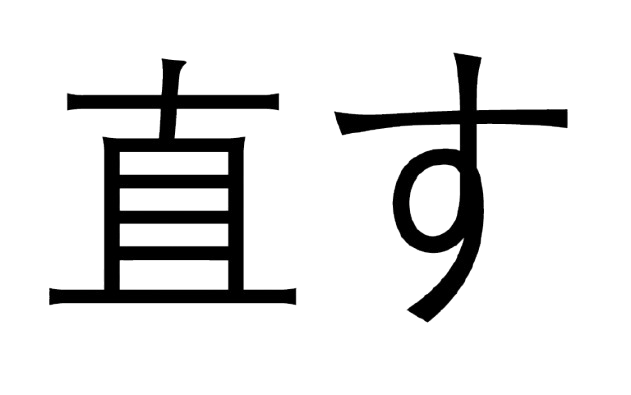
Kanji are characters the Japanese borrowed from Chinese. Many times, they look identical to their Chinese version, but oftentimes there are minute differences, like an extra line here, a gap there and so on. It is ideal to make sure one uses a font that makes sure to use the correct Japanese version. By default, your phone or computer will most likely use a Chinese font. You should make sure that you are using a Japanese font. I personally use an IPA font, but you're free to use any you feel look best. Use the images below for reference on what font the following character is displayed with: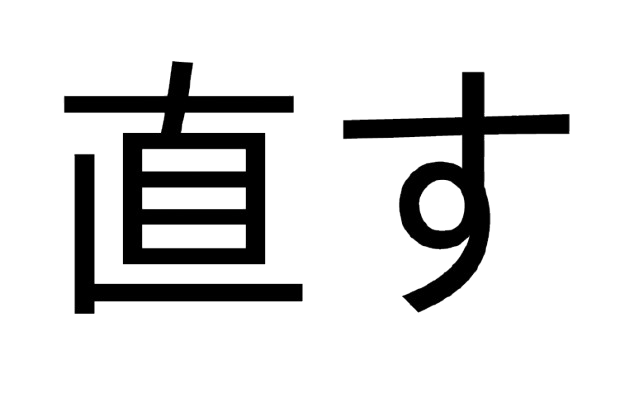
Radicals
Radicals are a subset of Kanji, that are used as "building blocks" in creating other Kanji. For instance, 木 is used to make 森, and so on. There are about 200 of them in all, and because by their nature they are the base building blocks, they are much easier to learn. I mean what looks easier to you to remember, 人 or 鬱? You probably can't even tell what the one on the right actually looks like in your browser without zooming in to like 400% (it is, however, one of the 2,200 "basic" kanji). A way of thinking about non-radical kanji is that they are "mental results" of what happens when you combine radicals. The prior example is a perfect encapsulation. 木 is the Kanji for "Tree". Many 木 together make 森, which is the Kanji for "Forest". This is how these Kanji have come about, historically. This historical process can be observed in some other more "fun" ways, for instance:田 (Rice Field) and 力 (Power) give us 男 (Man), whereas 少 (Few) and 力 (Power) give us 劣 (Inferior). You can probably see the historical reasoning.
Readings
The bane of your existence. Kanji can have multiple readings (i.e. it can be read in multiple different ways). The readings change depending on if they're by themselves (generally called "kun'yomi"), if they're part of a compound word (on'yomi), if they're on the left of a compound word, if they're on the right, other contextual clues. It's a nightmare, really. 生 itself has more than ten different readings. Also, it goes without saying but if you have 3,000+ "common" Kanji, you run out of unique readings pretty fast. Therefore, a lot of Kanji share readings, but you won't really have to worry about that for a while. Generally speaking, you will learn by repetition and exposure over time when reading and listening.Anki
This is the best piece of software with regards to language learning, hands down. It is a flashcard program, free to download (and open-source) with its own spaced repetition algorithm that calculates how often you see new cards. There's multiple guides for using Anki out there, so I'll skip that task :)With regards to a deck for learning radicals, I can recommend this deck, but you're free to use whichever you wish.